

A Visit from the Dragoncitos
A Classroom Full of Scaly Guests


From Fear to Fascination: How Connection Changes Everything
Many children begin their journey with reptiles feeling fear or discomfort.
Turning those feelings into fascination — and eventually into a desire to protect — takes time.
But it always starts with one thing: a moment of genuine closeness.
Our goal is to give children a positive, meaningful experience with reptiles.
Just as trust between people grows through direct contact, meeting a living animal can change how a child sees an entire group of species.
Not a Show — a Real Encounter
Our visits are not performances, and our animals are not props.
They are ambassadors, representing the many reptiles children rarely get to observe in nature.
In the wild, reptiles are quick and quiet:
lizards vanish in an instant, snakes glide away unseen.
There is little opportunity to watch them closely — let alone form a connection.
In the classroom, that changes.
Here, children can observe reptiles at their own pace, ask questions, and experience them safely and respectfully.
Each species we bring has a purpose.
Every animal illustrates a specific aspect of reptile life — behavior, adaptations, ecological roles — making learning personal, tangible, and memorable.
We’d like to take you with us for a moment and show you how a reptile presentation unfolds.
The introduction — filled with photos, short videos, and wide-eyed reactions — has just come to an end.
Now the children sit in a half-circle, leaning forward with anticipation, waiting to see what will happen next.
Feeding Behaviors
Leonie, our bearded dragon, waits in the first box — calm, patient, and the perfect animal to begin with.
Thirty voices rise at once:
“Is that an iguana?”
“Can I touch her?”
“Does she bite?”
“Can I take a picture?”
Everyone is talking at the same time.
Lili raises her voice just enough to be heard, still completely calm:
“If we all take a moment to settle down, we can see whether Leonie is hungry.”
With her spiky armor and broad, gentle face, Leonie really does look like a tiny dragon — and she’s waiting for her favorite moment of the day: feeding time.
Crickets and bits of lettuce disappear straight from the children’s hands.
As she eats, we explain how some reptiles change their diet as they grow — a pattern seen in bearded dragons and in the iguanas living near the children’s villages:
Young reptiles need protein-rich insects to grow quickly, while adults shift to leaves and plant material.


Morphology: How a Snake’s Body Tells Its Story
Then it’s time for the first snake: Cleopatra, our ball python.
A legend says that African rulers once wore this species as living adornment — draped around their arms and necks because of its beauty.
It’s from this tradition that her scientific name comes: Python regius, the royal python.
Her markings resemble those of the local boas, but Cleopatra is far more gentle — which makes her the perfect snake for children to meet up close.
We point out the heat-sensing pits around her mouth, explaining how these tiny organs allow her to find prey even in total darkness.
“What do you think these snakes eat?” Alexis asks.
Three children call out at once: “Mice!”
We had agreed they should raise their hands, but excitement sweeps the rule away.
None of them has ever been this close to a snake, and the moment overwhelms their self-control — but not their learning.
They immediately connect the dots to our earlier talk about snakes as natural controllers of rodent populations.
When the children gently hold Cleopatra, they feel the slow, steady strength of her muscles — the same power she uses to coil around her prey.
In their hands, it becomes unmistakably clear how a snake’s body and behavior are perfectly shaped for its way of life.
Endangered Species: Meeting the “Escorpión”
Next, we place a box in the center of the room. Inside is an animal many children know by name — the “Escorpión,” as people in the villages call it with fear.
It is a threatened arboreal alligator lizard: Abronia deppii.
Our Abronia is named Ferdinand — after the Berlin naturalist Ferdinand Deppe, who gave the species its scientific name.
In the local communities, these lizards are believed to be venomous and dangerous — probably because of their snake-like body, short legs, and broad head, which vaguely resembles a viper.
But the fear is unfounded: Abronias are completely harmless.
They have no venom, no fangs, no ability to injure people.
Still — when you’ve heard all your life that something is dangerous, that idea doesn’t disappear overnight.
We open the box.
The children’s eyes widen.
Ferdinand steps out with a gentle, wobbling gait, climbing over a piece of bark. His movements look almost like a dry leaf blowing in the wind.
His gray-black coloring, sprinkled with pale spots, blends perfectly with the bark and the lichens growing on it.
We tell the children:
Abronias have no weapons.
They cannot defend themselves against predators such as birds or martens.
Their only chance of survival is to remain unnoticed — through camouflage and careful, subtle movements.
Now the children are allowed to hold him.
Abronia deppii is one of the tamest lizards in Mexico.
Once Ferdinand sits quietly on their hands, looking at them with his shiny button eyes, the fear melts away.
“He’s so cute!” one girl whispers.
With Abronias in particular, we often see that a few minutes of real contact can change more than an hour of talking.
The children observe how Ferdinand wraps his prehensile tail around their fingers and uses it like an extra hand.
“Look! That’s how he holds onto branches!” a child exclaims.
We explain that Abronia deppii lives high in the epiphyte-covered oaks that still grow in the forests around the village — and that the species loses its home when these old trees are cut down.
Then the bravest children get to feed him a cricket from their hands.
Suddenly Ferdinands body tightens into an S-shape — now he really does look a little like a snake — and in a flash he lunges forward and snaps up the cricket.
The children cheer.
Ferdinand munches contentedly.
And in that moment, we take one small but meaningful step toward protecting a critically endangered species.


Activity Patterns
Next comes “Spidy,” our crested gecko.
Like Spiderman himself, he can run straight up the wall using the tiny lamellae on his feet.
When he sits on the children’s hands, licking fruit puree, they immediately notice the difference between his velvety, lamellar toes and the clawed feet of other lizards.
“He has eyes like my cat,” one little girl says.
We explain that some reptiles are active during the day, while others are nocturnal — and that night-active species have especially sensitive pupils that allow them to see even in complete darkness.
During the day, those pupils narrow to a thin slit.
As the children take turns looking into Spidy’s eyes, we talk about the gecko species native to Mexico — and which of them show similar behaviors.
Senses
Our next reptile always steals the show—over two feet of pure attitude:
Godzilla, our savannah monitor.
With his powerful body and dinosaur-like stance, he looks like a tiny T. rex, and the kids adore him instantly.
Alexis tells the group that savannah monitors come from Africa—lands shaped by buffalo, elephants, and lions.
It’s a tough neighborhood, but Godzilla isn’t intimidated. He’s a wild animal in his own right.
The children gather around as he explores a box filled with leaves and pieces of bark.
They watch, mesmerized, as his long, forked tongue flicks through the air, picking up invisible scent trails.
He zeroes in on the hidden roaches—shoving aside the substrate with strong limbs and sharp claws—
and then, lightning-fast, snap!
A wave of awe ripples through the room.
Alexis explains that monitors like Godzilla have giant relatives—creatures that look strikingly like the dinosaurs kids imagine—
and many of those species are endangered today.
“And just as we hope people in Africa protect their monitors,” he says,
“people around the world are counting on us—and on you—
to help protect the Dragoncitos that live high in our mountains here in Mexico.”



Roles in the Ecosystem
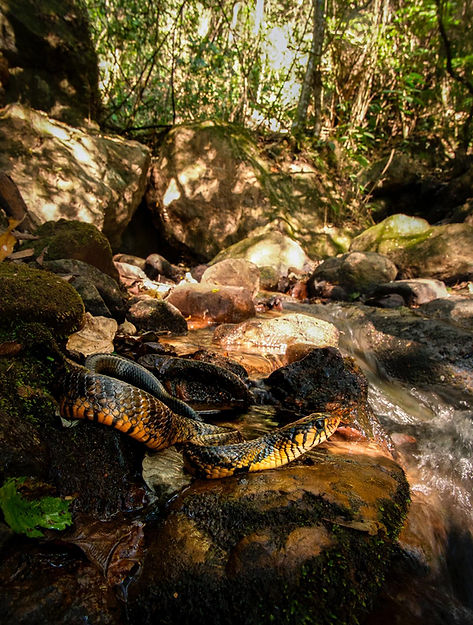
One of the most unforgettable moments of our program is the encounter with Blacky, the large black indigo snake.
Across many parts of Mexico, she’s considered the most frightening reptile of all.
In small rural towns, where life moves at a slower rhythm, people love a good story—especially the kind that carries a bit of mystery.
But that fondness for storytelling has also given rise to legends about the indigo snake—tales as imaginative as they are inaccurate, stories that have fueled fear and deep mistrust for generations.
“¡Qué miedo!” a boy blurts out—“That’s so scary!”—when he notices the box holding the snake.
One of the most widespread legends claims that indigo snakes sneak into farmhouses at night to drink breast milk from mothers—causing their babies to starve.
Another child chimes in:
“My grandma says the snake is so evil you can only kill it by stabbing a machete into the ground, putting a sombrero over it, and because it’s so aggressive, it bites the hat, wraps around the blade, and cuts itself into pieces.”
The belief that snakes intentionally enter villages to frighten or attack people is deeply ingrained.
And even though the kids have already learned a lot about reptiles during the lesson, you can still see the unease in their faces.
Does all that science really apply to this snake—the one sitting in the crate right in front of them?
Alexis speaks calmly, his voice steady and reassuring:
“There isn’t a reptile on Earth that drinks milk.
And snakes don’t attack people—hat or no hat.
If they can avoid us, they do.
They’re not here to scare anyone—they’re here because our fields and grain stores are full of mice.”
The truth is simple: this snake plays a vital ecological role.
She is nonvenomous and completely harmless to people.
We bring the large crate into the center of the circle.
The room falls silent—the moment everyone has been waiting for.
“Are you ready?” Lili asks, and slowly lifts the lid.
Blacky eases her glossy head out, tongue flicking gently through the air.
The kids remember: just like the monitor lizard, she uses chemical cues to navigate the world.
They notice her big, round eyes—a signature feature of diurnal species.
Now they understand why this snake is seen more often than those that move at night.
Her long, thick, ink-black body glides out of the box.
We place a dead mouse on the ground.
Every child leans forward, breath held, as she approaches the prey—and strikes with perfect precision.
She isn’t interested in people.
Her focus is on the rodents that thrive around homes and farms.
Suddenly, the relationship becomes clear:
Snakes don’t come looking for trouble.
They’re simply looking for food.
This new insight—earned through experience rather than fear—may save countless snakes in the future.
Many of these children have never seen a live snake up close, let alone watched one feed.
They are transfixed.
The sight of Blacky swallowing the mouse whole, without chewing, instantly becomes the story—
one they’ll retell for weeks, maybe months.
Today we didn’t just pass on facts.
We created new stories—true stories—powerful enough to stand against old myths.
Stories the children will carry home, share with their families, and keep alive in their communities.
And long after we’ve moved on to another mountain village, another classroom, meeting new children and creating new moments—
these stories will still be traveling.
And What About Venomous Snakes?
We’re honest about that, too.
During our lessons, we bring out preserved specimens—snakes we found already dead on the road.
Using these examples, the kids learn how to tell which species are venomous and which are not, and what signs to look for in the wild.
We also share a simple rule of thumb that applies only to these Mexican mountain regions:
If it has legs, it’s harmless.
If it doesn’t—snakes—give it space and respect.
Then we show the kids how to observe reptiles safely:
stay quiet, keep your distance, be patient.
Anyone who sits calmly beside a sun-warmed rock pile may soon spot a lizard slipping out to explore its world.


Saying Goodbye
At the end of the program, we gather in a circle one last time.
Each child gets to share which animal surprised them the most—or which one they loved best.
And then comes a moment everyone looks forward to:
anyone who wants can take a remembrance photo—
with Leonie in their arms, Cleopatra draped across their shoulders, or Spidy resting gently on their hand.
Many kids wave goodbye to the animals; some even whisper something to them.
And we know that the next time they see a lizard in a field or encounter a snake on a trail,
they’ll look at it differently—
with curiosity instead of fear.
That shift alone will save many Dragoncitos in the short term.
And in the long run, it lays the foundation for conservation efforts in which their habitats are protected together with the local communities who share these mountains.